
The historical trajectory of the Syrian Arab Republic unfolds through successive imperial systems, colonial administrations, and regional political experiments that shaped its modern identity. Geography placed Syria at the intersection of empires, while administrative restructurings repeatedly redefined sovereignty, borders, and symbols such as flags.
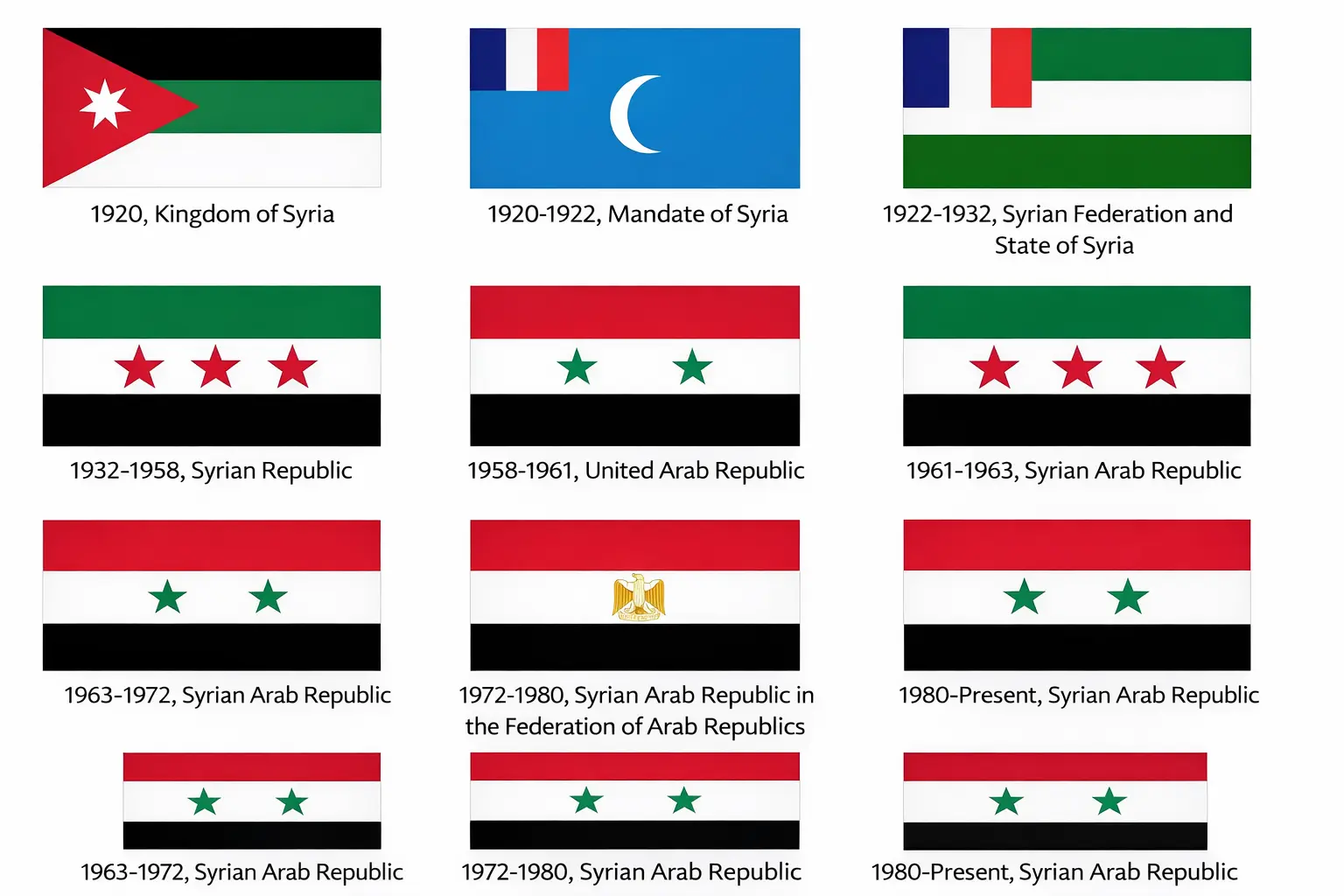
This chronology presents the major political phases from the early modern period to the contemporary republic, with attention to governance frameworks and historical context.
Ottoman Incorporation and Early European Intervention (1516–1840)
In 1516, Syria entered the administrative structure of the Ottoman Empire following the Battle of Marj Dabiq. Ottoman governance introduced provincial divisions integrated into imperial trade and military systems, anchoring Syria within a wider Mediterranean and Middle Eastern order.
By 1799, European military presence appeared along the Syrian coast during the French campaign led by Napoleon Bonaparte, marking a short but symbolically significant episode of external intervention.
In 1832, Egypt, under Muhammad Ali Pasha, assumed control of Syria while maintaining nominal Ottoman suzerainty. Centralized reforms and conscription altered local power relations until 1840, when direct Ottoman rule resumed after European diplomatic pressure.
From World War I to Fragmented Mandates (1918–1926)
The collapse of Ottoman authority during World War I transformed Syria’s political status. In 1918, local leaders proclaimed independence, though effective control shifted rapidly to British and French forces. The region experienced partition into zones: a British-administered southern area corresponding to Palestine, French-controlled coastal regions including Lebanon, and an interior Arab-administered Syria extending into 1919.
The Kingdom of Syria emerged briefly in 1920, reflecting Arab nationalist aspirations under King Faisal. The same year, France established the State of Greater Lebanon and reorganized the remaining territory into the State of Damascus and the State of Aleppo, each operating within the French Mandate framework.
In 1922, these entities merged into the Union of Syrian States, an arrangement that reflected administrative consolidation rather than full sovereignty. By 1923, Syria functioned formally as a League of Nations Mandate under France, a status continuing into the mid-1940s. The State of Syria designation appeared in 1925, while Lebanon became a separate mandate in 1926.
Republican Identity and World War II Era (1932–1946)
The proclamation of the Syrian Republic in 1932 signaled a constitutional shift within the mandate system, accompanied by the adoption of national symbols and flags expressing emerging statehood. Administrative continuity followed in 1939 under the State of Syria designation.
During World War II, authority shifted again. Between 1940 and 1941, administration aligned with Vichy France, followed by occupation by British and Free French forces until 1946. In 1941, the Syrian Republic reappeared as a political entity, and in 1944 independence from France was declared. Formal recognition of independence arrived in 1946, completing the transition from mandate to sovereign state.
Pan-Arab Experiments and the Modern State (1958–1977)
Regional political ideology reshaped Syria’s status during the Cold War era. In 1958, Syria joined Egypt in forming the United Arab Republic, an attempt at Arab unity that lasted until 1961. Following withdrawal from the union, the country adopted the name Syrian Arab Republic, emphasizing Arab nationalist orientation.
In 1963, discussions advanced toward an Arab Socialist Union involving Egypt, Iraq, and Syria, though implementation remained unrealized. Another integration effort followed in 1972 with the Federation of Arab Republics, uniting Egypt, Libya, and Syria under shared institutions and symbolism until 1977.
Flags as Political Markers
Throughout these transitions, flags functioned as visual expressions of authority and ideology. Ottoman banners reflected imperial rule, mandate-era flags indicated colonial administration, and republican flags incorporated pan-Arab colors symbolizing unity, independence, and political orientation. Each change in governance corresponded with symbolic recalibration, linking sovereignty to visual identity.
Conclusion
The history of the Syrian Arab Republic reflects layered governance rather than linear progression. Empires, mandates, kingdoms, and unions each contributed administrative practices and political language that continue to influence state structures. Understanding these dates and flags provides insight into how sovereignty in Syria evolved through negotiation between local aspirations and regional power dynamics, shaping a national identity rooted in historical complexity.
Comments are closed.